


Choosing a 4G industrial gateway for multi-country deployment? Learn how LTE bands, carrier plans, and site topology determine whether Y201-G, Y212-G, or Y212-GWR is the right fit.
A "global 4G gateway" is only global if its band support overlaps with the carriers you actually plan to use.
That sounds obvious, but it is one of the most common issues in industrial IoT deployments. Many buyers see "supports 4G LTE" in a datasheet and assume the device can be deployed anywhere. In practice, LTE is not a single worldwide lane. Each country, and often each carrier inside the same country, uses its own mix of LTE frequency bands.
For industrial projects, this matters because the cost of a wrong choice is rarely limited to one test unit. A gateway that works well in one country may attach poorly, lose coverage stability, or fail to register when deployed with a different carrier in another market.
This guide explains how to plan LTE band compatibility in a practical way. It also shows how to choose among three industrial gateway options from YenGear:
- Y201-G: compact 4G Cat.1 serial DTU
- Y212-G: industrial 4G Cat.4 serial gateway
- Y212-GWR: 4G Cat.4 gateway router with Wi-Fi and Ethernet
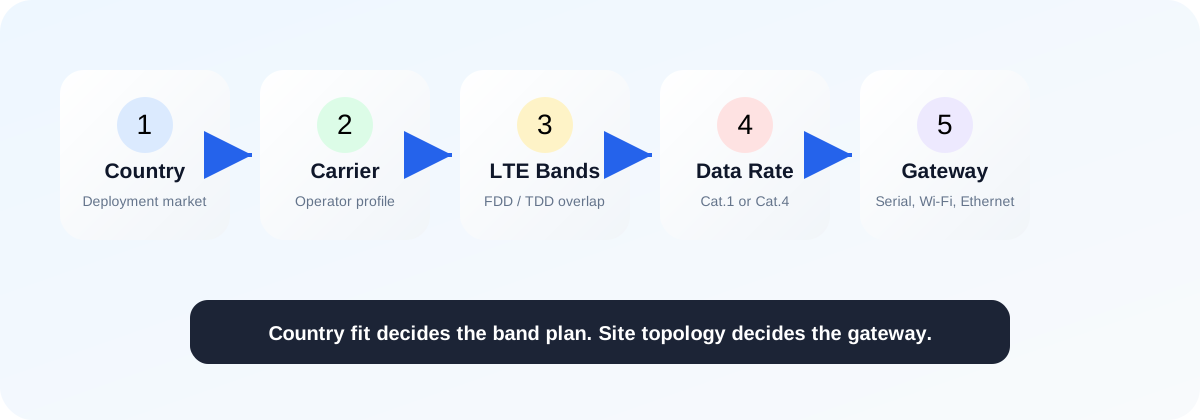
The main planning sequence is simple:
- List the deployment country.
- Confirm the preferred carrier.
- Check the carrier's LTE bands.
- Match those bands against the gateway.
- Select the right architecture for the site.
Use this article as a planning guide. Before mass deployment, confirm the target carrier, LTE band fit, and the exact product variant to be shipped.
Why "Supports 4G" Is Not Enough
LTE is the technology family. LTE bands are the local operating lanes.
A carrier may use B3 and B40 in one country, while another carrier uses B7, B20, or B28. Some regions rely heavily on TDD bands such as B38, B40, and B41. Others use more FDD bands such as B1, B3, B5, B7, B8, B20, and B28.
For a buyer, the important question is not:
Does this device support LTE?
The useful question is:
Does this product support the bands used by the carrier I actually plan to deploy with?
If the answer is no, the site may face several risks:
- Registration risk: the device may not attach to the LTE network.
- Coverage risk: the device may only use a weak or secondary band.
- Throughput risk: the device may connect but underperform.
- Deployment risk: one hardware SKU may not work across all target countries.
For consumer devices, a user can often change phones or operators. For industrial systems, gateways may be installed inside control cabinets, pump stations, agriculture sites, cold-chain warehouses, or remote monitoring boxes. Replacing them after deployment is expensive.
That is why LTE band planning should happen before purchase, not after field installation.
A Practical LTE Band Planning Map
The countries below are common planning targets for industrial IoT, smart agriculture, environmental monitoring, remote equipment control, and serial-to-cloud projects.
Y201-G, Y212-G, and Y212-GWR share the same LTE band baseline:
- FDD LTE: B1 / B3 / B5 / B8
- TDD LTE: B34 / B38 / B39 / B40 / B41
Y212-G and Y212-GWR also support 2G and 3G fallback. Y201-G is LTE-only.
This band set is intended for deployment across major markets in Asia, the Middle East, South America, and Europe, including India, Pakistan, Indonesia, Singapore, Iraq, Brazil, Cambodia, Nepal, Vietnam, Bangladesh, Syria, Algeria, the Philippines, Venezuela, Uzbekistan, Laos, Ethiopia, Argentina, Japan, South Korea, Ukraine, Germany, the United Kingdom, France, and Italy.
Final operator fit should still be confirmed against the target carrier before volume rollout.
South Asia and Southeast Asia
South Asia and Southeast Asia are often attractive markets for remote monitoring, metering, irrigation control, and distributed energy systems. They also show why country-level planning is not enough.
India commonly requires attention to B3, B5, B40, and B41, with B1 and B8 appearing in some deployment profiles. A gateway intended for India should not ignore TDD LTE, because B40 and B41 can be important in real carrier networks.
Pakistan planning commonly involves B3, B8, and B40, with operator-specific overlap sometimes extending to B1 or B7.
Indonesia commonly uses B1, B3, B8, B40, and B41. For industrial gateways, this creates a practical need for both FDD and TDD support.
Singapore may involve B1, B3, B7, B8, B38, B40, and B41, depending on the operator. The market is compact, but the band plan is not something to treat casually.
Cambodia, Vietnam, Bangladesh, the Philippines, and Laos also show mixed band environments. B1, B3, B8, and B40 appear frequently in regional planning, while B7, B28, and B41 may matter for specific carriers.
For projects in this region, the safest approach is to confirm the operator early. Do not assume that a gateway validated in one Southeast Asian country will automatically be optimal in the next.
Middle East, Central Asia, and Africa
For markets such as Iraq, Syria, Algeria, Ethiopia, and Uzbekistan, planning often involves a mixture of B3, B7, B8, B20, B28, and B40.
From a buyer's perspective, the key point is not to memorize every band. The key point is to treat these countries as operator-specific deployment markets. A gateway with B3, B8, and B40 may be a good fit for many applications, but any country where B7, B20, or B28 is important should be checked carefully against the final carrier.
If a project includes remote pumping stations, environmental monitoring systems, cold-chain storage sites, or off-grid agriculture assets, the quality of the local carrier network matters as much as the gateway itself.
Latin America
Latin America has several different LTE planning patterns.
Brazil commonly includes B3, B7, and B38 in reference planning, depending on the carrier. This makes it a good example of why a simple "LATAM support" statement is not specific enough.
Venezuela planning may involve B3, B7, B8, B28, and B40.
Argentina commonly involves B4, B7, B28, and B40.
Other South American regions may include B2, B3, B4, B7, B13, B17, B28, and B38. If a project is planned across multiple countries, one hardware configuration may not cover every carrier equally well.
For industrial rollouts, it is best to build a country-and-carrier table before procurement. That table should include the planned SIM provider, required bands, installation environment, expected data volume, and whether the site needs backup connectivity.
Europe, Japan, and South Korea
Europe is often treated as a simpler region, but it still requires verification.
Germany, the United Kingdom, France, Ukraine, and Italy commonly involve bands such as B3, B7, B8, B20, B28, B32, B38, and B40. A gateway may support the core LTE bands needed for one operator but miss bands used by another carrier for coverage or capacity.
Japan is one of the clearest examples of why buyers should not rely on a vague regional label. NTT DoCoMo, SoftBank, and KDDI use different combinations that may include B1, B3, B8, B11, B18, B19, B21, B26, B28, and B41.
South Korea also varies by operator. SKT, KT, and LGU+ do not use identical band profiles. Even inside one country, carrier selection can change the hardware decision.
For developed-market deployments, the issue is less about whether 4G exists and more about whether the selected gateway supports the correct bands for the intended carrier and installation location.
How to Use Regional Module Labels
Buyers often see module labels such as CE, E, J, A, or AU in datasheets and product materials. These labels are not universal telecom standards. They are usually manufacturer-side shorthand for regional module variants.
They can still be useful as a first-pass filter.
| Module shorthand | Typical planning region | Practical meaning |
|---|---|---|
| CE | China / India oriented | Often needs strong TDD support such as B38 / B39 / B40 / B41, plus common FDD bands |
| E | Parts of Asia and Europe | Usually a mixed FDD profile with some TDD support depending on the module |
| J | Japan specific | Japan has a distinct carrier-band environment and should be checked carefully |
| A | United States focused | North American band plans are highly carrier-specific |
| AU | Brazil / selected LATAM references | Latin American deployments should still be checked by carrier |
Use these labels to narrow the shortlist, but do not use them as the final decision. Two modules with the same regional label may still support different band subsets.
Module labels narrow the search. Carrier band lists close the decision.
Where Y201-G, Y212-G, and Y212-GWR Fit
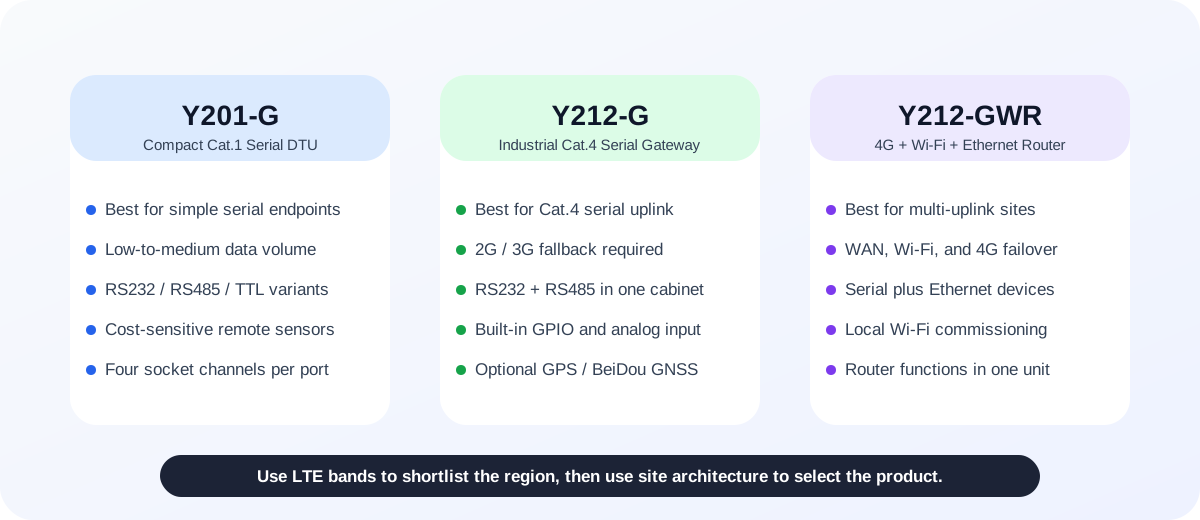
Band compatibility is only one part of the product decision. Once the LTE bands are acceptable, the next question is the site architecture.
All three products share the same LTE band baseline:
- FDD LTE B1 / B3 / B5 / B8
- TDD LTE B34 / B38 / B39 / B40 / B41
The selection difference is mainly about:
- Cat.1 vs Cat.4 data rate
- LTE-only vs 2G / 3G fallback
- Simple serial uplink vs serial + Wi-Fi + Ethernet routing
- Whether the cabinet needs failover or local maintenance access
Y201-G: Compact Cat.1 DTU for Simple Serial Endpoints
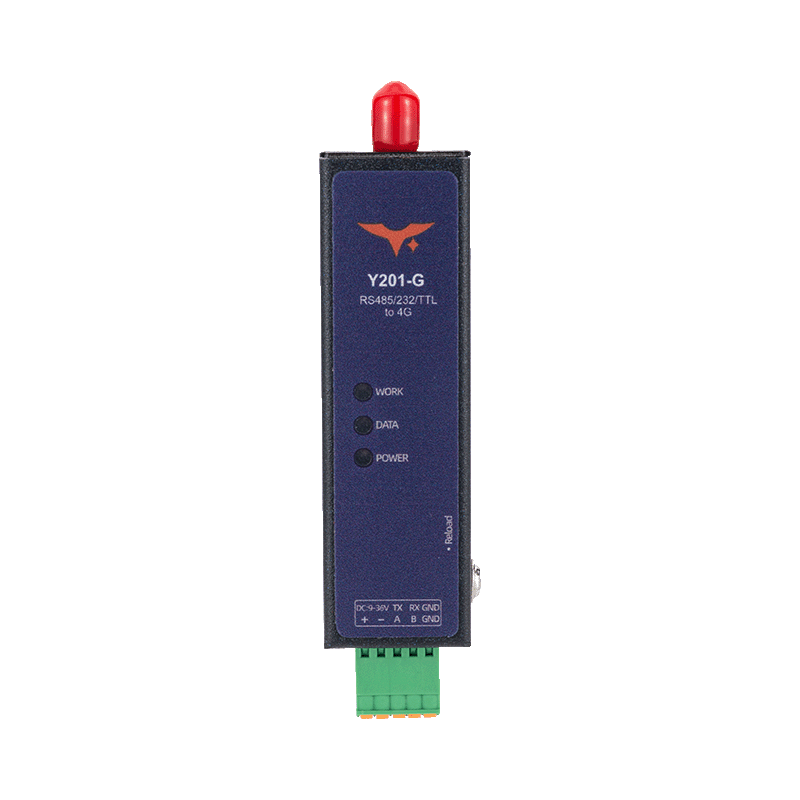
Y201-G is the best fit when the site only needs a compact cellular uplink for serial data.
It is suitable for simple sensor nodes, meters, data acquisition points, agricultural monitoring boxes, and other endpoints where the device sends small or moderate data packets to a remote server.
Key features include:
- Compact industrial 4G Cat.1 serial DTU
- RS232, RS485, or TTL interface variants
- 9 to 36 VDC wide-range power input
- Four concurrent Socket channels per serial port
- TCP, UDP, HTTP, MQTT, peer-to-peer, and SMS transparent transmission
- Active Modbus polling and JSON reporting
- Extended temperature version from -40 to 85°C
Choose Y201-G when the site is a simple serial endpoint that needs a cost-effective cellular uplink and does not require Cat.4 throughput.
Y212-G: Industrial Cat.4 Serial Gateway
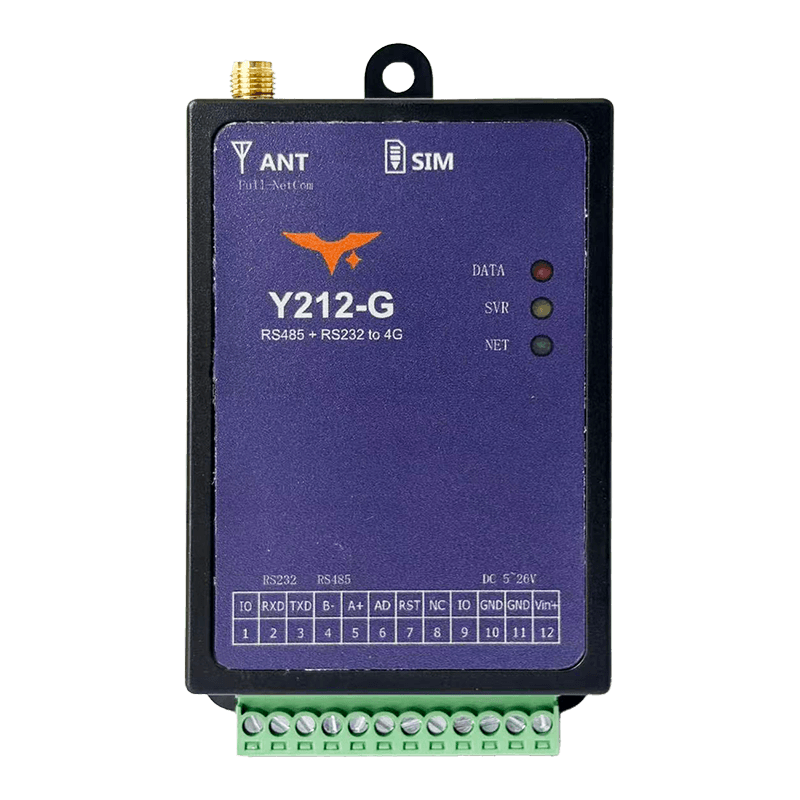
Y212-G is a stronger fit when the site needs Cat.4 throughput, industrial I/O, and a dedicated serial-to-cellular architecture.
It is useful for RS232 and RS485 assets in remote cabinets where the main job is to connect field equipment to a cloud platform, SCADA system, MQTT broker, or TCP server.
Key features include:
- Industrial 4G Cat.4 serial gateway
- 2G and 3G fallback support
- RS232 and RS485 on shared terminal
- TCP, UDP, HTTP, HTTPS, MQTT, MQTTS, and WebSocket
- 2 GPIO channels plus one 0 to 8 V analog input
- Optional BeiDou + GPS GNSS module
- 6 to 28 VDC input with reverse-polarity and surge protection
- Operating temperature from -40 to 85°C
- MTBF greater than 200,000 hours
Choose Y212-G when the project is fundamentally a serial-device-to-cellular-cloud connection and requires Cat.4 speed, built-in I/O, or stronger remote maintenance capability.
Y212-GWR: Tri-Mode Gateway Router for 4G, Wi-Fi, and Ethernet
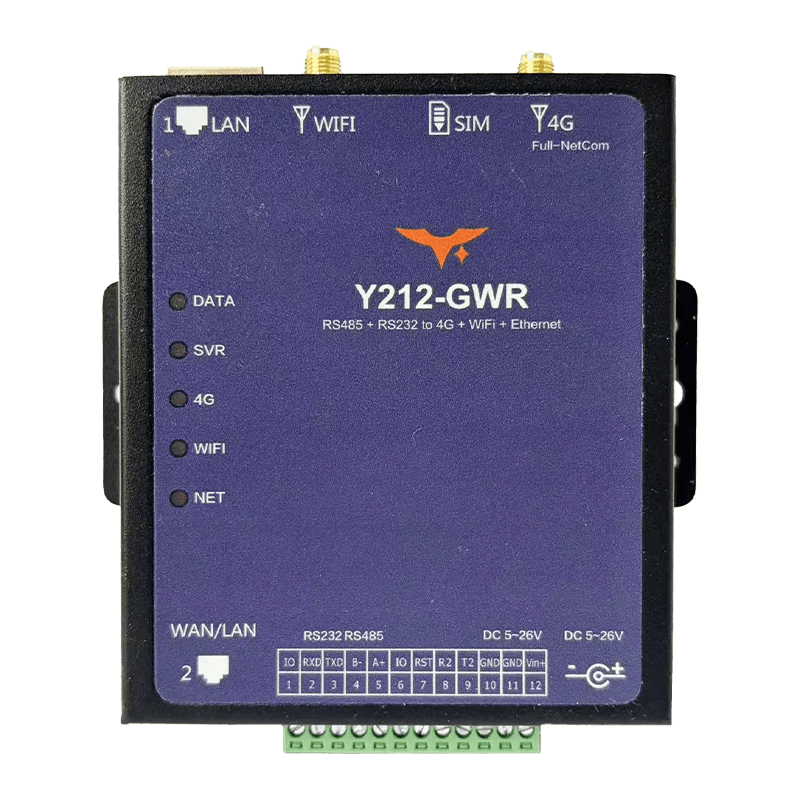
Y212-GWR is the best fit when LTE band compatibility is only part of the requirement. Some sites also need local Ethernet, Wi-Fi, WAN backup, or automatic uplink switching.
This is common in cabinets with mixed serial and IP devices, remote PLCs, maintenance laptops, cameras, or edge controllers.
Key features include:
- 4G LTE Cat.4, Wi-Fi 802.11 b/g/n, and dual RJ45 Ethernet
- RS232 and RS485, plus optional TTL secondary UART
- Default link priority of WAN > Wi-Fi > 4G
- Automatic network switching
- AP and STA Wi-Fi modes
- Configurable IO support
- Remote OTA, logs, and diagnostics
- 6 to 26 VDC input
- Operating temperature from -40 to 85°C
Choose Y212-GWR when the site needs local routing, WAN backup, Wi-Fi-based commissioning, Ethernet devices, or uplink redundancy.
Quick Selection Reference
| If your project needs... | Better fit | Why |
|---|---|---|
| Compact cellular uplink for a simple serial sensor or meter | Y201-G | Cat.1 DTU with a small form factor |
| Multiple simultaneous cloud connections from one serial port | Y201-G | Four concurrent Socket channels per port |
| Cat.4 throughput with built-in GPIO and analog input | Y212-G | Industrial Cat.4 gateway with I/O |
| One RS232 / RS485 path to the cloud | Y212-G | Clean serial-to-cellular architecture |
| Serial plus WAN, Wi-Fi, and backup uplink switching | Y212-GWR | Multi-uplink router with automatic failover |
| Local Wi-Fi setup or maintenance access | Y212-GWR | AP / STA Wi-Fi support |
| Mixed serial and Ethernet devices in the same cabinet | Y212-GWR | Dual RJ45 plus serial interfaces |
A Seven-Step Buyer Workflow
Use this workflow before releasing a production order:
- List every deployment country. Include future expansion markets, not only the first pilot country.
- List the preferred carrier in each country. If the carrier is not final, mark the project as not ready for volume hardware selection.
- Map carrier bands against the gateway. Check both FDD and TDD bands.
- Assess the data volume. Simple telemetry may only need Cat.1. Higher data rates may justify Cat.4.
- Define the site topology. Decide whether the cabinet needs only serial-to-4G or also Wi-Fi, Ethernet, WAN, and failover.
- Select the gateway. Choose Y201-G, Y212-G, or Y212-GWR based on the site architecture.
- Confirm the exact product variant before rollout. Validate with the target operator, SIM provider, and deployment location.
Country fit decides the band plan. Data rate and site topology decide the gateway architecture.
Common Mistakes in Industrial LTE Gateway Selection
Mistake 1: Buying only by the phrase "supports 4G"
A buyer orders 500 units for a deployment, only to find that the gateway supports a different regional band set from the local carrier network. The device can see LTE service in theory but cannot register reliably in the field.
The fix is to compare the carrier bands before purchase.
Mistake 2: Assuming one country means one band plan
One operator in a country may use a different band combination from another operator. A gateway tested with one SIM may not perform the same way with another SIM.
The fix is to validate by carrier, not only by country.
Mistake 3: Treating Japan, China, or the United States as simple markets
These markets can be highly carrier-specific. A broad regional label such as "Asia" or "North America" is not enough.
The fix is to check the target operator and the exact module variant.
Mistake 4: Overspecifying Cat.4 for simple meter reading
If a device reports a small data packet every few minutes or every hour, Cat.1 may be sufficient. Cat.4 can be unnecessary for large deployments of simple endpoints.
The fix is to match the LTE category to the real data volume.
Mistake 5: Choosing a serial gateway when the cabinet needs routing
A site may start as a simple RS485 project, then later require Ethernet devices, Wi-Fi maintenance, or WAN backup. If this is known at the planning stage, a gateway router may be the better choice.
The fix is to define the cabinet topology before selecting the product.
Conclusion
Global LTE success starts with country and carrier planning. A product that supports 4G is not automatically suitable for every market, every operator, or every site architecture.
For industrial projects, the best selection process is:
- Confirm the deployment country and carrier.
- Check the LTE band overlap.
- Decide whether the site needs Cat.1 or Cat.4.
- Decide whether the cabinet needs only serial uplink or also Wi-Fi, Ethernet, and failover.
- Select the gateway that matches both the network and the field architecture.
As a simple rule:
- Choose Y201-G for compact, cost-sensitive Cat.1 serial endpoints.
- Choose Y212-G for Cat.4 serial-to-cellular gateways with industrial I/O.
- Choose Y212-GWR for sites that also need WAN, Wi-Fi, Ethernet, routing, or uplink redundancy.
Before mass deployment, confirm the target carrier, LTE band fit, and final product variant.